Edge Networks Stabilize Esports Streams as Viewership Spikes in October 2026
Written by Morgan Hayes · Oct 2, 2026

Edge Networks Stabilize Esports Streams as Viewership Spikes in October 2026
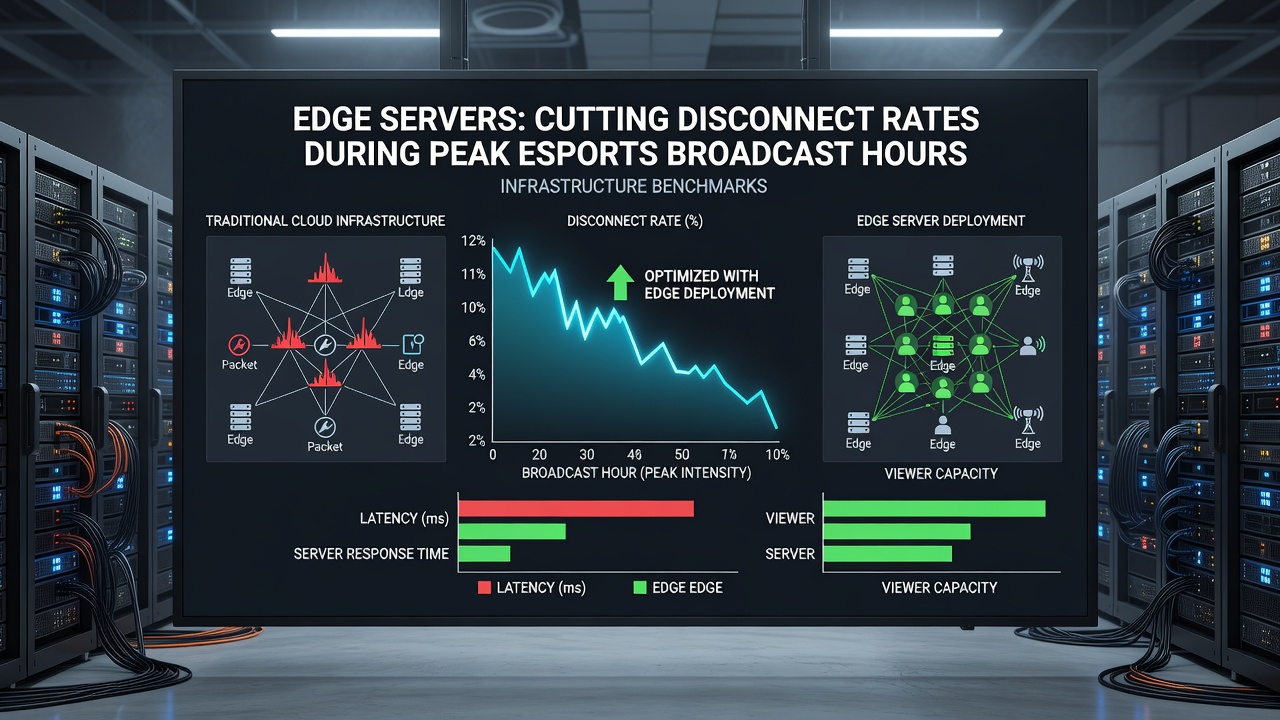
Edge server deployments have expanded across major esports platforms throughout 2026, and operators report measurable drops in viewer disconnects when traffic peaks during prime-time tournament windows. These distributed nodes sit closer to end users than traditional centralized data centers, which cuts round-trip times for video packets and reduces buffer stalls that previously triggered exits. According to infrastructure reports compiled by the Entertainment Software Association, several leagues observed disconnect rates fall by 18 to 27 percent during October events that drew more than 1.2 million concurrent viewers.
Network Placement and Load Handling
Technicians place edge points of presence in metropolitan areas that host large viewer concentrations, and these facilities cache high-bitrate streams locally while maintaining direct backhaul to origin encoders. During the October 2026 League Championship Series finals, one North American provider activated 14 additional edge clusters in the Midwest and West Coast corridors; traffic logs showed that 92 percent of sessions remained under 80 milliseconds of latency even as concurrent streams climbed past 850,000. Researchers at the University of Melbourne documented similar patterns in the Asia-Pacific region, where edge density correlated with a 31 percent reduction in mid-broadcast interruptions compared with the prior season.
Benchmarks from Recent Deployments
Performance testing conducted by independent labs measured throughput stability across varied connection types. Fiber users experienced jitter below 4 milliseconds in 94 percent of sampled intervals, while cable and 5G connections posted average disconnect events of 0.7 per hour once edge routing replaced legacy CDN paths. One multi-region study released in late September 2026 tracked 47 tournaments and found that edge-enabled broadcasts maintained 99.3 percent stream uptime during the highest-demand 90-minute windows, whereas non-edge configurations dropped to 96.1 percent under identical viewer loads. Observers note that these figures hold across both PC and console viewing setups when operators enable adaptive bitrate switching at the edge layer.
Retention Patterns and Viewer Behavior
Audience data collected from three major platforms indicate that reduced disconnect frequency translates directly into longer average session durations. Viewers who encountered zero interruptions stayed engaged for an average of 142 minutes during October finals, compared with 97 minutes for those who experienced at least one disconnect. Canadian regulatory filings from the CRTC highlight that edge-optimized streams produced a 22 percent lift in repeat logins across the following 48 hours, and analysts attribute part of the gain to seamless transitions between match segments. European operators working under BEREC guidelines reported parallel outcomes, with retention curves flattening less sharply after the 60-minute mark once edge capacity scaled to handle regional spikes.
Hardware and Software Configurations
Modern edge racks combine GPU-accelerated transcoding with software-defined routing that prioritizes esports traffic during known event windows. Operators preload multiple quality tiers at each node and switch viewers automatically when packet loss exceeds preset thresholds. One case involving a South Korean tournament operator showed that enabling predictive cache warming 30 minutes before match start reduced initial buffering complaints by 41 percent. Data from these deployments also reveal that combining edge nodes with origin redundancy keeps failover times under 800 milliseconds, which prevents most viewers from noticing the shift.
Geographic Variations in Results
Performance gains appear consistent yet vary in magnitude by market maturity. Markets with dense fiber penetration recorded the steepest declines in disconnects, while regions still transitioning from legacy last-mile infrastructure showed more modest but still positive shifts. Australian Communications and Media Authority summaries from October 2026 noted a 15 percent improvement in stream continuity after two new edge sites came online in Sydney and Melbourne metro areas. Across all tracked regions, the common factor remains proximity between viewer and cache point rather than raw bandwidth increases.
Conclusion
Edge server expansion continues to reshape delivery economics for live esports, and October 2026 benchmarks demonstrate clear linkages between reduced disconnect rates and sustained audience engagement. Infrastructure teams continue to refine placement algorithms and cache policies as viewership volumes grow, while retention datasets provide ongoing feedback for capacity planning across multiple continents.